
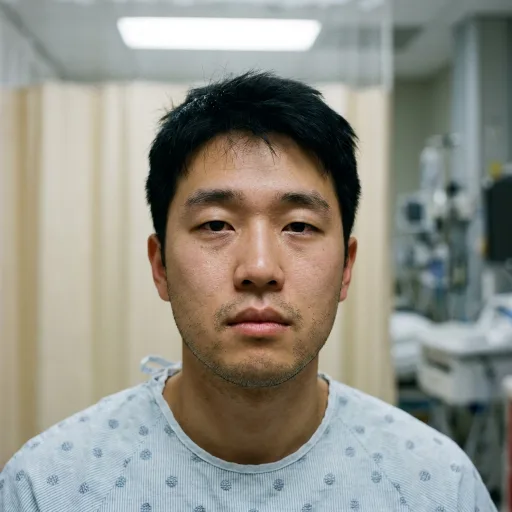
Right lower quadrant pain
3m 41s encounter
This is an unedited encounter from ClinicalSim. Review the same recording, transcript, and feedback report the learner received.
The scenario
Your role
You are a third-year medical student on your emergency medicine rotation, seeing a new patient in ED Bay 12 before your attending.
Ethan Park, a 24-year-old graduate student, came in with his roommate this morning with abdominal pain that started last night. Triage notes he is uncomfortable and lying still on the stretcher.
Take a focused history, examine him, order what you need, and tell him what you think is going on and what happens next.
Exam findings, vital signs and test results appear on your screen when you ask for them. Just say what you're checking or ordering, for example "I'm going to check your vital signs" or "Let's get a CBC."
Objectives
- Take a focused history of acute abdominal pain, including onset, migration and associated symptoms
- Request vital signs and a targeted abdominal exam, including signs of peritoneal irritation
- Order and interpret appropriate labs and imaging
- Form a working diagnosis and start initial management
- Explain the diagnosis and plan to the patient in plain language
Listen to the recording
Hear the 3m 41s recording
The feedback shown is a regrade of this encounter against the current version of the checklist, which was published after the encounter was recorded.
Transcript41
Hey... sorry... I can't really sit up right now.
Hey, Ethan. I'm Dr. Conway, one of the doctors in the emergency department. I hear your stomach's bothering you.
Can you tell me a little bit more about what's going on?
Yeah... my stomach. It really hurts.
Okay. When did it start and where was it at first?
Last night... around ten. It was kinda... around my belly button at first.
And where is it now?
Down here... lower right side. It moved.
How bad is it on a scale of zero to 10? Does anything make it better or worse?
Like a seven just lying here... worse when I move. Even talking kinda hurts.
Okay, Ethan, I'm gonna check your vital signs now.
Okay.
Okay. Those look okay. Um, now I'm gonna press on your belly.
Can you tell me where it hurts? I'm gonna do an abdominal exam.
Mmm... Ow... yeah, right there. Lower right. That's the spot.
Okay. Can you lift your right leg against my hand?
Ugh... yeah that hurts too. On the right.
Okay. Um, I also need to do a quick testicular exam to make sure nothing's going on there.
Oh... uh, okay. Yeah, go ahead.
Okay. Um, so Ethan, uh, I am going to get some labs done just to make sure everything's okay. I'd like to get some blood work, uh, a CBC and basic metabolic panel.
Okay... yeah, whatever you need.
Okay.
Can I... get something for the pain? Please?
Um, not quite yet. We will be getting you something soon. I just wanna see what's going on first.
Can we also get a CRP and a lipase?
Okay...
Okay.
Is it... my appendix? My friend had that in college.
Uh-huh.
...
Yeah. That, that is my concern, Ethan, is that it might be your appendix. Um, I wanna get a, a urinalysis as well, so we're gonna have you, um, go to the bathroom and, and come back, and we'll look at the urinalysis.
Okay... I'll try. Um... do I need surgery?
I'm gonna order a CT scan of your a- abdomen and pelvis.
Okay...
Do I... am I gonna need surgery?
So it looks like you have, um, appendicitis, so I'm gonna start an IV, give you fluids, and something strong for the pain, and we'll also start antibiotics. I don't want you to eat or drink anything for now.
Okay... yes please, something for the pain. So... does that mean surgery? Like today?
Um, probably soon. I'm gonna call the surgeons now, but before we do that, I wanna recheck your vital signs now that you've had fluids.
Okay...
Am I gonna be okay?
Ethan, you're gonna be okay. Uh, it seems like we've caught this, uh, early enough, and so I'm calling the surgeons, um, and you should be back to class in a week or so.
Okay... that's a relief. Um... can you let my roommate know what's going on? He's out in the waiting room.
Sure. I'll let your roommate know. Uh, the surgical team will be by shortly.
Okay... thank you. Honestly I feel a lot better knowing what's going on.
Feedback
How to read this feedback
Every score is written as value / max, so you can see both the points earned and the points available. A spoken simulation can’t surface everything a real visit would, so when something couldn’t be judged fairly, the feedback labels it instead of holding it against you. Here’s what each label means.
(simulation limitation)The voice/text modality physically can't reveal it
e.g. eye contact, body language, facial affect, physical exam, EHR documentation
(no opportunity)The scenario never created the occasion
e.g. conversation ended before this step; situation never arose
(not applicable)Out of scope for this case
e.g. a domain that doesn't apply here
A not assessable item does not affect the score. The format did not give you a fair chance to show that behavior, so the item is excluded. That is different from “Not demonstrated,” where the moment was there and the skill didn’t come through. Only the second one reflects on how the encounter went.
For competency frameworks with levels, some scenarios can only assess a competency up to a certain level because the higher levels turn on behaviors a single spoken encounter can’t surface. When a scenario’s ceiling is below Level 4, that milestone is still shown for its formative value but is “Not in overall grade” . It doesn’t count toward the overall grade, so a case that can’t fully exercise a competency never reads as a shortfall.
Intro/Greeting
You opened well, greeting the patient by name and introducing yourself as a doctor in the emergency department.
Chief Concern
You elicited the reason for the visit with an open-ended invitation to describe what was going on.
HPI for Abdominal Pain
You covered onset, the full periumbilical-to-right-lower-quadrant migration, and severity on a 0 to 10 scale, and you asked an open better-or-worse question. You did not ask about the quality of the pain or what the patient had tried for it.
Associated Symptoms
You did not ask about nausea, vomiting, appetite, fever or chills at any point in the history.
Pertinent Negatives
You did not ask the patient about bowel changes, urinary symptoms, or testicular or groin symptoms, even though you later ordered a urinalysis and performed a testicular exam.
History
This whole section was missed: you did not ask about past medical or surgical history, current medications, allergies or social history, and the allergy gap is notable given you started antibiotics.
Physical Exam
You checked vitals, examined the abdomen while localizing tenderness, performed a right-sided hip provocation maneuver, and appropriately prepared the patient for a testicular exam. Naming the specific peritoneal and psoas signs aloud would make your reasoning clearer.
Diagnostic Testing
You ordered a thorough workup: CBC, basic metabolic panel, lipase, CRP, urinalysis and a CT of the abdomen and pelvis.
Management
You delivered strong management, keeping the patient NPO, starting IV fluids and antibiotics, offering pain control, consulting surgery and rechecking vitals after fluids.
Assessment
You clearly named appendicitis as the working diagnosis for the patient.
Closing
You reassured the patient and outlined next steps, but you did not directly answer the repeated question about surgery or check understanding and invite questions.
Overall impression
-
Strengths: Your workup and management were excellent and well sequenced: a focused HPI capturing the classic migration, a complete lab and imaging workup, and textbook management with NPO status, IV fluids, antibiotics, analgesia, a surgical consult and post-treatment reassessment. You also named the diagnosis clearly and prepared the patient thoughtfully for a sensitive exam.
-
Priority gaps: The history was thin outside the pain itself. You asked no associated symptoms (nausea, vomiting, appetite, fever/chills), no pertinent negatives (bowel, urinary, groin), and no past history, medications, allergies or social history. The missing allergy check is a safety concern because you ordered antibiotics.
At closing, the patient asked about surgery three times and never received a direct answer.
-
Top action items
- Build a habit of a brief associated-symptoms and pertinent-negatives screen (nausea/vomiting/appetite, fever/chills, bowel, urinary, groin) before moving to the exam.
- Always capture allergies, medications and relevant past history before ordering drugs, especially antibiotics.
- At closing, answer the patient's actual question directly. Confirm the likely appendectomy. Then check understanding and invite questions.
- Name the specific signs you are eliciting during the exam (rebound, Rovsing, psoas) to make your clinical reasoning explicit.
Formative use only. This feedback is AI-generated for education and professional development. It is not a clinical judgment or a credentialing determination, and must not be used as the sole basis for any promotion, remediation, credentialing, or other consequential decision. Responsibility for evaluation and personnel decisions stays with the program and its faculty.
References
-
Classic presentation: Moris D, Paulson EK, Pappas TN. Diagnosis and management of acute appendicitis in adults: a review. JAMA. 2021;326(22):2299-2311. doi:10.1001/jama.2021.20502. Supports: the classic sequence of vague periumbilical pain, then anorexia, nausea or vomiting, migration of pain to the right lower quadrant and low-grade fever, and that most patients who present this way have appendicitis.
-
Value of the history and exam: Wagner JM, McKinney WP, Carpenter JL. Does this patient have appendicitis? JAMA. 1996;276(19):1589-1594. doi:10.1001/jama.1996.03540190061030. Supports: right lower quadrant pain, rigidity, migration of pain and a positive psoas sign as the findings that most raise the likelihood of appendicitis, and vomiting that starts before the pain as a finding against it. The Rovsing and obturator signs are less well studied in adults.
-
No single finding is diagnostic: Andersson REB. Meta-analysis of the clinical and laboratory diagnosis of appendicitis. Br J Surg. 2004;91(1):28-37. doi:10.1002/bjs.4464. Supports: that each symptom, sign and test discriminates weakly alone; peritoneal irritation, migration of pain, leukocytosis, a left shift and an elevated C-reactive protein carry the most information, and are strongest in combination.
-
Clinical scores: Alvarado A. A practical score for the early diagnosis of acute appendicitis. Ann Emerg Med. 1986;15(5):557-564. doi:10.1016/S0196-0644(86)80993-3. Supports: the eight-item, ten-point Alvarado score (migration of pain, anorexia, nausea or vomiting, right lower quadrant tenderness, rebound, fever, leukocytosis, left shift). Current guidance prefers the AIR and AAS scores in adults (reference 5, statement 1.4).
-
Diagnosis and management guideline: Di Saverio S, Podda M, De Simone B, et al. Diagnosis and treatment of acute appendicitis: 2020 update of the WSES Jerusalem guidelines. World J Emerg Surg. 2020;15(1):27. doi:10.1186/s13017-020-00306-3. Supports: risk stratification with a clinical score before imaging (statement 1.4); an in-hospital delay of up to 24 hours as safe for uncomplicated appendicitis, and no longer (statements 3.1 and 3.2); laparoscopic appendectomy as the preferred operation; a single preoperative dose of broad-spectrum antibiotics, and no postoperative antibiotics for uncomplicated disease (7.1 and 7.4). WSES favors ultrasound first, with CT when ultrasound is negative or equivocal; US practice favors CT first (reference 6). Either is accepted in this case.
-
Imaging in a non-pregnant adult: Kambadakone AR, Santillan CS, et al; Expert Panel on Gastrointestinal Imaging. ACR Appropriateness Criteria® Right Lower Quadrant Pain: 2022 Update. J Am Coll Radiol. 2022;19(11S):S445-S461. doi:10.1016/j.jacr.2022.09.011. Supports: CT of the abdomen and pelvis with IV contrast as usually appropriate initial imaging for suspected appendicitis in a non-pregnant adult with fever and leukocytosis, and ultrasound as a may-be-appropriate alternative.
-
Reading the CT: Choi D, Park H, Lee YR, et al. The most useful findings for diagnosing acute appendicitis on contrast-enhanced helical CT. Acta Radiol. 2003;44(6):574-582. doi:10.1046/j.1600-0455.2003.00146.x. Supports: an appendiceal diameter over 6 mm, wall thickening, wall enhancement and periappendiceal fat stranding as the most useful CT findings. Kim HY, et al. Systematic review and meta-analysis of CT features for differentiating complicated and uncomplicated appendicitis. Radiology. 2018;287(1):104-115. doi:10.1148/radiol.2017171260. Supports: an extraluminal appendicolith, abscess, a defect in wall enhancement and extraluminal air as features of complicated appendicitis; without them the CT reads as uncomplicated.
-
Early analgesia: Manterola C, Vial M, Moraga J, Astudillo P. Analgesia in patients with acute abdominal pain. Cochrane Database Syst Rev. 2011;(1):CD005660. doi:10.1002/14651858.CD005660.pub3. Supports: giving opioid analgesia before the diagnosis is made; in randomized trials it relieved pain without increasing diagnostic or treatment-decision errors.
-
Antibiotic choice: Solomkin JS, Mazuski JE, Bradley JS, et al. Diagnosis and management of complicated intra-abdominal infection in adults and children: guidelines by the Surgical Infection Society and the Infectious Diseases Society of America. Clin Infect Dis. 2010;50(2):133-164. doi:10.1086/649554. Supports: regimens for mild-to-moderate community-acquired intra-abdominal infection, such as ceftriaxone plus metronidazole, cefoxitin or ertapenem, and avoiding ampicillin-sulbactam because of E. coli resistance.
-
Antibiotics instead of surgery: CODA Collaborative; Flum DR, Davidson GH, Monsell SE, et al. A randomized trial comparing antibiotics with appendectomy for appendicitis. N Engl J Med. 2020;383(20):1907-1919. doi:10.1056/NEJMoa2014320. Supports: antibiotics alone as an option the surgical team may discuss, noninferior to appendectomy on 30-day health status, with about three in ten patients needing an appendectomy by 90 days (more with an appendicolith).
-
Recovery after laparoscopic surgery: Jaschinski T, Mosch CG, Eikermann M, Neugebauer EA, Sauerland S. Laparoscopic versus open surgery for suspected appendicitis. Cochrane Database Syst Rev. 2018;11(11):CD001546. doi:10.1002/14651858.CD001546.pub4. Supports: a shorter hospital stay and an earlier return to normal activity after laparoscopic than after open appendectomy.
-
Excluding pancreatitis: Tenner S, Vege SS, Sheth SG, et al. American College of Gastroenterology guidelines: management of acute pancreatitis. Am J Gastroenterol. 2024;119:419-437. doi:10.14309/ajg.0000000000002645. Supports: a lipase above three times the upper limit of normal as a diagnostic criterion for acute pancreatitis; a normal lipase argues against it.
-
Explaining the plan: Kurtz S, Silverman J, Benson J, Draper J. Marrying content and process in clinical method teaching: enhancing the Calgary-Cambridge guides. Acad Med. 2003;78(8):802-809. doi:10.1097/00001888-200308000-00011. Talevski J, Wong Shee A, Rasmussen B, Kemp G, Beauchamp A. Teach-back: a systematic review of implementation and impacts. PLoS One. 2020;15(4):e0231350. doi:10.1371/journal.pone.0231350. Supports: the closing item, explaining the diagnosis and plan in plain language and checking understanding.
-
Lab reference ranges: Mayo Clinic Laboratories. Test catalog: complete blood count with differential (test 9109), basic metabolic panel (BMAMA), glucose, random (GLURA), C-reactive protein (CRP) and lipase (LPS). Accessed November 10, 2026. https://www.mayocliniclabs.com/test-catalog. Supports: the adult male reference ranges shown with the lab results.
Other examples
Goals of Care: medically complex child
A PICU fellow talks with a mother about worsening respiratory failure, what returning home could mean, and how palliative care can support her family.
Disclosing an Incidental Finding of Metastatic Disease With No Known Primary
A man expects an appointment about back pain and learns that his scan suggests cancer in his spine. They discuss what happens next and how to involve his wife.
Goals of Care in Progressive Osteosarcoma
A father asks to drain the fluid around his daughter's lung and keep worsening cancer news from her. The conversation turns to comfort and how to include her.
48 Hours in the Hallway
Frank Miller, 78, has been boarding in an emergency department hallway bed for 48 hours while he waits for an ERCP and an inpatient bed, and his daughter Tiffany wants to know what is happening.
Addressing Hydroxyurea Nonadherence and Medical Mistrust
Monique Williams is the mother and primary caregiver of Jordan, thirteen, who has HbSS sickle cell disease.
Delivering a New Leukemia Diagnosis to a Family in the Emergency Department
Ethan Morales, a previously healthy 7 year old, came to the emergency department with two weeks of fatigue, bruising, intermittent fevers, and leg pain.
Informed Consent Discussion for Central Venous Catheter Placement in the PICU
Noah Harris, a previously healthy five year old, was admitted to the PICU about thirty minutes ago with septic shock secondary to pneumonia.
Pediatric Vaccine Hesitancy Counseling
Your patient, Ava Mitchell, is a healthy full term infant due for her first routine vaccine series today (DTaP, IPV, Hib, PCV20, Rotavirus, and Hepatitis B).
Discharge counseling with limited English proficiency
A pediatrics resident uses teach-back to help a mother with limited English tell her son's daily asthma inhaler from his rescue inhaler, then sorts out a spacer, his medicines, and follow-up near home.
This is what a learner receives
Every completed practice session produces a report tied to the frameworks named on the case and the evidence in the transcript.