
Disclosing an Incidental Finding of Metastatic Disease With No Known Primary
5m 11s encounter
This is an unedited encounter from ClinicalSim. Review the same recording, transcript, and feedback report the learner received.
The scenario
Your role
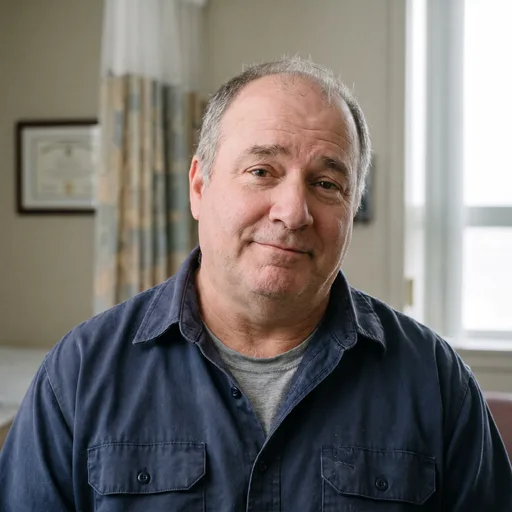
**You are Dennis Boyd's primary care physician** and have been for six years. He came to you three months ago with low back pain. You imaged it because of features that concerned you. The MRI report is in front of you and he is in the waiting room, expecting to hear about physiotherapy.
Dennis Boyd, 58, has had low back pain for three months. He put it down to lifting at work. You imaged it because of what he told you at the last visit: the pain now wakes him at night, it has not improved with conservative management, and he has lost weight he was not trying to lose.
The MRI shows diffuse low marrow signal with heterogeneously enhancing lesions at multiple levels through the lower thoracic and lumbar spine, together with a compression fracture. There is no evidence of cord compression. The appearances are reported as consistent with metastatic disease. No primary site is identified.
So you know two things and not a third. This is cancer, and it has spread to bone. Where it came from is not yet known, and finding out means further imaging and a biopsy.
He has no frame for any of this. He is here for a back appointment. He came alone.
The clinical ground you are standing on. Imaging for low back pain is indicated where features suggest a serious underlying condition: his age, pain that wakes him, failure to improve, and unexplained weight loss are what justified it. There is no cord compression, so this is a disclosure rather than an emergency transfer. The compression fracture is pathological, arising in bone weakened by disease, which accounts for the change in his pain and means the vertebra is structurally compromised.
A metastatic presentation with no identified primary is a recognized clinical situation, not an incomplete workup; next steps are further imaging and referral, and you are not expected to detail the diagnostic sequence beyond that or to know which spine service takes it locally. Prognosis cannot be stated at this point: it depends on the primary, the histology and the extent of disease, none of which is known. "I cannot give you a number yet" is the correct answer, and it is different from refusing to answer.
Formative use only. The output of this case is faculty-development evidence. It is never a summative judgment of clinical or communication competence, and never an input to appointment, promotion, compensation, credentialing, peer review, or any employment action.
Objectives
- Find out what he thinks the scan was for, and what he has already been worrying about, before giving any result.
- Give a warning shot, then say plainly that the scan shows cancer that has spread to the bone, using the word.
- Say that the source is not yet known, explain how it will be found, and do not fill the gap with a guess.
- Respond to the emotion before adding more information, and treat his silence as needing time rather than as agreement.
- Decline to give a prognosis, say what it depends on, and give him a concrete next step with a name and a timeframe.
- Convey that follow-up is urgent rather than routine, name the services involved: oncology plus a spine service: and give him activity guidance and the symptoms that would mean being seen immediately.
Listen to the recording
Hear the 5m 11s recording
▶Transcript23
So is it a disc? My wife's convinced I've done something to a disc.
Hi, Mr. Boyd. Uh, yeah, tell me a little bit more about that.
Well, I've been lifting at work for thirty years, so it made sense. The pain's been there about three months now, and honestly the weekend was better, I almost didn't come in today. Marlene's been telling me to rest it, and I've been trying.
Okay. Uh, well, I'm glad you did come in because I do have some difficult news to share with you. The scan that we got for your back pain shows cancer, and I'm worried that, uh, this is a metastasis from a primary cancer that we have not yet been able to identify.
...Cancer. Cancer of what?
We don't know that yet. We're gonna need to do some more imaging and some more blood work and fully evaluate to see where the cancer is from. But I can say that the c- there is cancer in your bone, which is kind of why we're having this conversation.
In the bone. Right. So you can see it's there but you can't tell where it started.
How do you find that out?
Uh, first of all, I just wanna say I'm so sorry to be having this conversation with you, and I can only imagine how painful this is to hear. Um, but, you know, I wanna tell you that we can work on this and figure out where the cancer is coming from and do a more thorough evaluation before we make any determinations about prognosis or kind of what comes next.
Okay. How long does that take, the finding out where it's from?
So I think we need to start working on this right away. Um, you know, uh, depending on what type of cancer is the primary, it, you know, it could be days, possibly a few weeks, depending on how much for the evaluation we need. But I think this is something urgent and not routine.
We should really get started on this as soon as possible.
Days to a few weeks. Alright. Should I have brought my wife?
She doesn't know I'm here today. I told her it was just the back again.
I, I completely understand, and, you know, I wanna help you through that. So if you would like me to speak with her directly, if you think, you know, I should join you in a conversation with her, uh, whatever you think is best, but I'm here to support you and help you with that.
Thank you. I think... I'd like to call her. Can I bring her back in, maybe later today or tomorrow, and you tell her what you told me?
Absolutely. Uh, just let me know, and I will make time for you. Uh, this is very important to me, and I wanna be there for you as, you know, since I've been taking care of you for so long.
I wanna make sure that we really see this through together.
I appreciate that. I really do. Can I ask... what do I do today?
Like, right now, when I walk out of here. And what about work? I'm a supervisor, but I'm still lifting most days.
Okay, let me make some phone calls. I'm gonna figure out how quickly I can get you in to see oncology and a spinal specialist, and, um, hopefully in the next few days we can get the timeline sorted out.
Okay. Oncology and a spine specialist. In the next few days.
And the lifting? Should I be at work Monday?
You can be at work, but I wouldn't lift anything. Now, if the pain becomes significantly worse, or if you start to feel, um, you know, if you start to feel sick in general, meaning, like, you know, lightheadedness, headaches, fevers, those kinds of things, just stay home and give me a call.
No lifting. Got it. I'll tell them Monday.
And anything else I should watch for with the back itself? Like, is there something that means I need to be seen right away, not wait for the appointment?
I think, like, what I mentioned. So if you, you know, if you start having fe- fevers or other constitutional symptoms, meaning, like, lightheadedness, headaches, sweats, those kinds of things. Related to your back pain, though, if the pain gets worse or if it starts shooting up and down your legs or anything like that, or if you start to feel like you can't walk or you're losing sensation, definitely call me.
Do not wait for your appointment.
Okay. Worse pain, shooting down the legs, trouble walking, losing feeling. I'll call you.
So let me make sure I've got this. The scan showed cancer in the bone in my back, but you don't know yet where it started, and that's what the next tests are for. Oncology and a spine specialist in the next few days.
No lifting. Call you if things get worse.
That's absolutely right. Okay, let's talk soon.
Alright. I'm gonna go call Marlene from the parking lot. I'll bring her in with me next time.
Thank you. For not... for just telling me straight.
Feedback
How to read this feedback
Every score is written as value / max, so you can see both the points earned and the points available. A spoken simulation can’t surface everything a real visit would, so when something couldn’t be judged fairly, the feedback labels it instead of holding it against you. Here’s what each label means.
(simulation limitation)The voice/text modality physically can't reveal it
e.g. eye contact, body language, facial affect, physical exam, EHR documentation
(no opportunity)The scenario never created the occasion
e.g. conversation ended before this step; situation never arose
(not applicable)Out of scope for this case
e.g. a domain that doesn't apply here
A not assessable item does not affect the score. The format did not give you a fair chance to show that behavior, so the item is excluded. That is different from “Not demonstrated,” where the moment was there and the skill didn’t come through. Only the second one reflects on how the encounter went.
For competency frameworks with levels, some scenarios can only assess a competency up to a certain level because the higher levels turn on behaviors a single spoken encounter can’t surface. When a scenario’s ceiling is below Level 4, that milestone is still shown for its formative value but is “Not in overall grade” . It doesn’t count toward the overall grade, so a case that can’t fully exercise a competency never reads as a shortfall.
Overall impression
- Strengths: The learner delivered a real warning shot, used plain non-technical language, avoided false reassurance, and offered a genuine empathic acknowledgment. The closing was particularly strong: a concrete urgent plan, excellent specific safety-netting, sensitive support of the patient's wish to involve his wife, and a confirmed teach-back. The patient's parting thanks for telling him straight reflects a respectful encounter.
- Priority gaps: Two early SPIKES steps were compressed or skipped: the patient's invitation was never sought, and his perception was only lightly explored before disclosure. The knowledge and emotion steps, while competent, moved to information and plan quickly rather than chunking the news and pausing to let emotion breathe.
- Top action items
- Before disclosing, ask an explicit perception question and then obtain an invitation about how much the patient wants to know.
- Deliver the diagnosis in small chunks with a comprehension check after each.
- Name the emotion and allow silence before pivoting to reassurance or planning.
- Briefly confirm readiness before launching into the management plan.
Formative use only. This feedback is AI-generated for education and professional development. It is not a clinical judgment or a credentialing determination, and must not be used as the sole basis for any promotion, remediation, credentialing, or other consequential decision. Responsibility for evaluation and personnel decisions stays with the program and its faculty.
Other examples
Discussing Relapsed Sarcoma and Limited Curative Options
A father wants to do whatever it takes after his daughter's sarcoma relapses. They discuss limited curative options and how to bring her into the conversation.
Goals of Care Discussion in Progressive Respiratory Failure
Partial conversation: a daughter recalls her father's wish to avoid prolonged life support, but he has no written advance directive. The conversation ends before a care plan is agreed.
48 Hours in the Hallway
Frank Miller, 78, has been boarding in an emergency department hallway bed for 48 hours while he waits for an ERCP and an inpatient bed, and his daughter Tiffany wants to know what is happening.
Addressing Hydroxyurea Nonadherence and Medical Mistrust
Monique Williams is the mother and primary caregiver of Jordan, thirteen, who has HbSS sickle cell disease.
Delivering a New Leukemia Diagnosis to a Family in the Emergency Department
Ethan Morales, a previously healthy 7 year old, came to the emergency department with two weeks of fatigue, bruising, intermittent fevers, and leg pain.
Informed Consent Discussion for Central Venous Catheter Placement in the PICU
Noah Harris, a previously healthy five year old, was admitted to the PICU about thirty minutes ago with septic shock secondary to pneumonia.
Pediatric Vaccine Hesitancy Counseling
Your patient, Ava Mitchell, is a healthy full term infant due for her first routine vaccine series today (DTaP, IPV, Hib, PCV20, Rotavirus, and Hepatitis B).
Goals of Care: medically complex child
A pediatric resident talks with the mother of a medically complex child about his quality of life, her concerns, and what comfort could mean for him.