
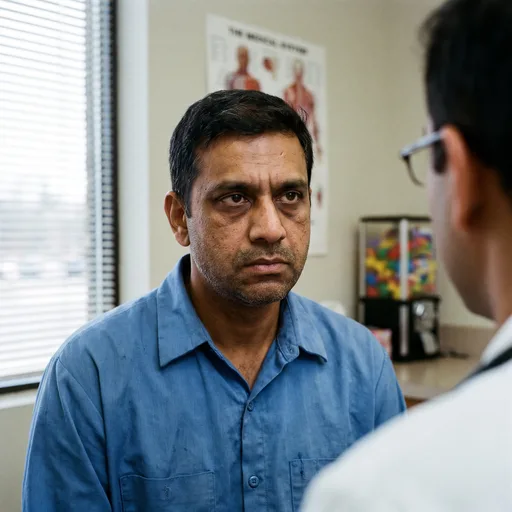
Discussing Relapsed Sarcoma and Limited Curative Options
6m 9s encounter
This is an unedited encounter from ClinicalSim. Review the same recording, transcript, and feedback report the learner received.
The scenario
Your role
You are the pediatric hematology-oncology fellow caring for Maya, a 15-year-old with metastatic Ewing sarcoma.
Maya completed multimodal therapy about 11 months ago. New surveillance imaging now shows widespread pulmonary and osseous relapse, and curative options are very limited: the realistic remaining options are palliative-intent chemotherapy and possible clinical-trial enrollment.
You are meeting Maya's father, Ravi, one-on-one in an outpatient oncology clinic room. He asked to speak with you before Maya joins. He came expecting to talk about the next round of chemotherapy and does not yet know the disease has relapsed widely.
His wife died of cancer three years ago, which colors how he hears everything today.
Your task is to disclose the relapse clearly and compassionately, discuss prognosis honestly, introduce palliative-focused treatment and trial options without alarming jargon, explore the family's values, and begin to consider how to include Maya in decisions about her care.
Objectives
- Communicate disease relapse clearly and compassionately, with a warning shot and honest framing.
- Discuss prognostic uncertainty while preserving the therapeutic alliance and realistic hope.
- Explore the family's values and the father's conflicting goals during an emotionally charged conversation.
- Introduce palliative-focused treatment and clinical-trial options accurately and without alarming jargon.
- Advocate for developmentally appropriate inclusion of the adolescent patient in decisions about her care.
Listen to the recording
Hear the 6m 9s recording
▶Transcript27
Doctor, before you bring Maya in, I want to talk first. Just tell me what the next round of chemo looks like. We are going to do whatever it takes.
Hi, Robbie. This is Dr. Risman. I've been able to take care of Maya for the last couple of years, and, and I hear you and that you wanna talk without Maya.
Um, I think it's important if we bring her in soon so we can all talk together.
I hear you, and we will bring her in. But please... give me a few minutes first. I need to understand where we are before she walks in.
So... what do the scans show? What is the next line of treatment?
So, I'm, I'm happy to share those, um, results with you. Can you share a little bit about what you've seen in Maya for the last couple of months?
She has seemed... okay. Tired, maybe. A little more quiet than usual, but I thought that was just being fifteen.
She has been eating, going to school. Nothing that made me think we were back in trouble. Why... what did the scans show?
So, the scans show that Maya has progression of her Ewing sarcoma to both her lungs and her bones.
...both her lungs and her bones. ...Okay. ...Could the scans be wrong? Could it be something else, an infection, scar tissue from before?
Um, I hear the hope in your voice, and I also hope too, but I'm, I'm quite worried that this is progression of her underlying disease.
...Okay. ...Then we treat it. There has to be another line of chemo, something stronger. What is next?
You are not giving up on her, right?
So I would never give up on Maya. Um, and, and I'm gonna be honest with you, I really don't have great options for her, but I'm gonna share the two options that I do have. And again, I think it's really important that we start thinking through how we incorporate Maya into this decision.
...Okay. Tell me the two options. And... I hear you about Maya.
Just... let me understand it first, then we will talk about her. Please.
So the two options for Maya, one is that we enroll her in a clinical trial. Um, and what that means is you'd meet our research team, they'd talk through risks and benefits with you and also with Maya, because both of you have to agree to pursue this option together.
Okay. A trial. ...And the other option?
So the other option is something called palliative chemotherapy. And what this means is that because we don't have a cure for Maya, what we're hoping to do is decrease the rate of progression of her disease and really promote comfort.
...Palliative. ...So you are telling me there is no cure. ...That word... does that mean hospice? Are you saying we are just... making her comfortable until she dies?
So it's a little bit different. So hospice is when somebody dies within the next six months, and the goal is to be comfortable and stay out of the hospital. In Maya's case, if you wanna keep pursuing chemotherapy, it's called palliative chemotherapy, in that we know that there's no cure, but the hope is that we try to decrease the disease burden that she has.
Okay. ...So palliative chemo is still treatment. It is just not... aiming for cure. ...I need to sit with that. ...Please just be honest with me. How much time are we realistically talking about?
I am not asking for a guarantee. I just need the range.
So I can't tell you for certain because I don't have a crystal ball and because everybody's cancer responds a little bit differently to chemotherapy.
I understand you do not have a crystal ball. But you have treated this disease before. You must have some sense.
Are we talking weeks, months, a year, more? Please. I cannot plan for my daughter if you will not give me even a range.
So I can imagine that without any treatment, you would have weeks to months, and with treatment, you might have months to years.
...Okay. ...Months to years. ...Thank you for saying it plainly. ...My wife died of cancer three years ago. Maya watched it. I watched it.
And now I am sitting here being told... ...I do not know how to do this again.
You don't have to do it alone. You know, I want you to know that we're all a team and we're all here on the journey together. And so when we bring Maya into this, it'll be me and you, and we could have our child life team and our social worker there for support as well.
Thank you. ...That helps. ...I have not asked Maya what she wants. I have been so focused on protecting her that I... I did not think she should have to carry this. But she is fifteen.
She is going to know something is wrong. ...How do I even begin to talk to her about this?
We'll do it together. I think it'll probably help by showing her the scans and talk through what the scans look like and what it means for her and what decisions she has to start thinking about for her life so that we make sure she's living each day as she wants to be.
Okay. ...Together. I can do that if you are in the room with me. ...Let us bring her in. I want her to hear it from both of us.
And I want to hear what she wants. ...I am scared, but I think she has earned the right to be part of this.
It is scary, and we'll do it together. I'm sure she feels scared too.
Okay. ...Thank you for being honest with me. I do not think I could have heard this if you had dressed it up. Let us go get her.
Feedback
How to read this feedback
Every score is written as value / max, so you can see both the points earned and the points available. A spoken simulation can’t surface everything a real visit would, so when something couldn’t be judged fairly, the feedback labels it instead of holding it against you. Here’s what each label means.
(simulation limitation)The voice/text modality physically can't reveal it
e.g. eye contact, body language, facial affect, physical exam, EHR documentation
(no opportunity)The scenario never created the occasion
e.g. conversation ended before this step; situation never arose
(not applicable)Out of scope for this case
e.g. a domain that doesn't apply here
A not assessable item does not affect the score. The format did not give you a fair chance to show that behavior, so the item is excluded. That is different from “Not demonstrated,” where the moment was there and the skill didn’t come through. Only the second one reflects on how the encounter went.
For competency frameworks with levels, some scenarios can only assess a competency up to a certain level because the higher levels turn on behaviors a single spoken encounter can’t surface. When a scenario’s ceiling is below Level 4, that milestone is still shown for its formative value but is “Not in overall grade” . It doesn’t count toward the overall grade, so a case that can’t fully exercise a competency never reads as a shortfall.
Overall impression
-
Strengths: The learner delivered difficult news honestly and in plain language, resisted the father's pressure to offer false hope ("I really don't have great options for her"), and provided a clear prognostic range when directly asked. The repeated commitment to partnership: "You don't have to do it alone," "We'll do it together": was genuine and helped the father move from protective denial to readiness to include Maya. The conversation ended with a meaningful shift in the father's stance, which reflects real skill in holding a difficult encounter.
-
Priority gaps: The most significant gap is the near-complete absence of the Map and Align steps. The learner never asked Robbie what matters most to him or to Maya, and therefore never synthesized or confirmed values before moving to a plan. The plan was presented as a menu of options rather than a recommendation grounded in the family's priorities.
Additionally, the single most emotionally charged moment in the encounter: the father's disclosure that his wife died of cancer and "I do not know how to do this again": received a supportive but logistically oriented response rather than a deep empathic acknowledgment. The overall tone was warm and honest, but the conversation was driven more by information delivery than by values exploration.
-
Top action items
- Map before planning: Before presenting options, ask explicitly what matters most to the patient and family: "What are you most hoping for? What are you most afraid of?": and use those answers to frame the plan.
- Name the emotion at peak moments: When the father disclosed his wife's death, pause and name the specific grief before moving forward: e.g., "That is an enormous loss, and now you're facing this again. I can only imagine how that feels."
- Align explicitly: After any values exploration, reflect back what you heard and confirm it: "It sounds like what matters most is X and Y: is that right?": before transitioning to a plan.
- Tie the recommendation to values: Frame the plan as a recommendation connected to stated priorities, not just a list of options, and check the family's reaction: "Given what you've told me, here's what I would suggest, and here's why: what do you think?"
Formative use only. This feedback is AI-generated for education and professional development. It is not a clinical judgment or a credentialing determination, and must not be used as the sole basis for any promotion, remediation, credentialing, or other consequential decision. Responsibility for evaluation and personnel decisions stays with the program and its faculty.
References
- Mack JW et al. Communication about prognosis with adolescent and young adult patients with cancer. Pediatr Blood Cancer. 2018.
- Kaye EC et al. The impact of specialty pediatric palliative care in oncology: a systematic review. CA Cancer J Clin. 2021.
- Hesla AC, Papakonstantinou A, Tsagkozis P. Current Status of Management and Outcome for Patients with Ewing Sarcoma. Cancers (Basel). 2021;13(6):1202. Published 2021 Mar 10.
- Childers JW et al. REMAP: a framework for goals of care conversations. J Oncol Pract. 2017.
- Sisk BA et al. Prognostic disclosures over time: parental preferences and physician practices. Cancer. 2017.
Other examples
Goals of Care Discussion in Progressive Respiratory Failure
Partial conversation: a daughter recalls her father's wish to avoid prolonged life support, but he has no written advance directive. The conversation ends before a care plan is agreed.
Disclosing an Incidental Finding of Metastatic Disease With No Known Primary
A man comes in expecting an explanation for his back pain and learns that imaging shows cancer in his spine. The conversation covers uncertainty and next steps.
48 Hours in the Hallway
Frank Miller, 78, has been boarding in an emergency department hallway bed for 48 hours while he waits for an ERCP and an inpatient bed, and his daughter Tiffany wants to know what is happening.
Addressing Hydroxyurea Nonadherence and Medical Mistrust
Monique Williams is the mother and primary caregiver of Jordan, thirteen, who has HbSS sickle cell disease.
Delivering a New Leukemia Diagnosis to a Family in the Emergency Department
Ethan Morales, a previously healthy 7 year old, came to the emergency department with two weeks of fatigue, bruising, intermittent fevers, and leg pain.
Informed Consent Discussion for Central Venous Catheter Placement in the PICU
Noah Harris, a previously healthy five year old, was admitted to the PICU about thirty minutes ago with septic shock secondary to pneumonia.
Pediatric Vaccine Hesitancy Counseling
Your patient, Ava Mitchell, is a healthy full term infant due for her first routine vaccine series today (DTaP, IPV, Hib, PCV20, Rotavirus, and Hepatitis B).
Goals of Care: medically complex child
A pediatric resident talks with the mother of a medically complex child about his quality of life, her concerns, and what comfort could mean for him.