
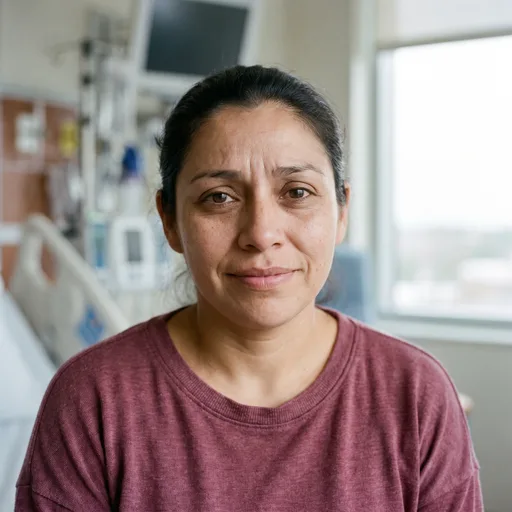
Discharge counseling with limited English proficiency
8m 22s encounter
This is an unedited encounter from ClinicalSim. Review the same recording, transcript, and feedback report the learner received.
The scenario
Your role
You are a Pediatrics Resident on the general inpatient floor team conducting discharge counseling.
Your patient, Thomas, a 6-year-old boy with moderate persistent asthma, is ready for discharge after a hospitalization for status asthmaticus. He is going home on a daily controller inhaler (budesonide) and a rescue inhaler (albuterol). His mother, Mrs. Elena Alvarez, is at the bedside holding the discharge paperwork, tired but eager to go home.
It is about 2 hours before they leave. She primarily speaks Spanish, has limited English proficiency, and has declined an interpreter, preferring to speak directly with you. You need to counsel her on the medications, return precautions, and follow-up in a way she can truly understand.
Objectives
- Identify the language barrier and adapt your communication style accordingly
- Simplify discharge instructions to plain language
- Confirm understanding using the teach-back method
- Identify discharge barriers (transportation, pharmacy access, follow-up)
Listen to the recording
Hear the 8m 22s recording
Transcript61
I'm sorry… I don't understand which medicine he needs every day.
Hi, Mrs. Alvarez. I'm Dr. Dorian, one of Thomas's doctors. Um, I'm here to go over how to take care of him at home.
Um, would you like a interpreter? We have a Spanish interpreter here.
No… thank you, doctor. I want to talk with you. I try my best in English.
Okay, great. I'll make sure I speak slowly, and please stop me anytime. There are no silly questions.
Okay… thank you. I'm just worried. He was so sick…
I know. Before I explain, can you tell me what the team, uh, told you about his two inhalers?
Um… they showed me two. One is orange, I think, and one is… maybe brown? But I don't know which one is every day and which one is for when he can't breathe.
I'm sorry…
What worries you most about going home?
That it happens again… that he can't breathe and I don't know what to do. That scares me the most.
Yeah, I can, I can understand that. That would be very frightening. We're gonna make sure you know exactly what to do when you go home.
...
Um, sure. So Thomas has two inhalers. The first is the everyday one.
It's called, uh, budesonide. He uses it every day, morning and night, even when he feels good. It's what keeps his lungs calm.
Okay… every day, morning and night, even if he feels okay. That one keeps his lungs calm.
Yes. And the second one is the rescue one, so that's if he's not doing well. That one is called albuterol.
Okay… the rescue one is for when he can't breathe good. Only when he needs it, not every day. Is that right?
That's correct. You should use it only when he's coughing a lot, wheezing, or breathing hard.
Okay… I understand. And if I give him the rescue one and he still can't breathe good… what do I do then?
What you should do is make sure that you bring him to the emergency room immediately.
Okay… and should I call nine one one, or just drive him myself?
It depends on his condition. If he really can't breathe well, I would call nine one one. If it's just not going away, then I would bring him in to the emergency room.
Okay… if he's really bad, I call nine one one. If it's just not getting better, I bring him in. I understand.
Do you have a spacer?
No… I don't have one. What is a spacer?
A spacer is the plastic tube that goes on the inhaler.
Oh… no, I don't have that at home. Is it important?
Yes, it's important. We'll make sure to give you one before you leave.
Okay… thank you. That helps.
Okay. I wanna make sure I explained it well. Can you tell me, in your own words, which inhaler he uses every day and which one is for when he can't breathe?
Mmm... Yes… the everyday one is budesonide. He uses it morning and night to keep his lungs calm. The rescue one is albuterol, and he uses it only when he can't breathe well, like if he's coughing a lot or wheezing.
If that doesn't help, I go to the emergency room or call nine one one if it's really bad.
That's exactly right. Thank you for repeating that to me. Um, so when you should worry is if he coughs or wheezes tonight, you should be giving him the rescue inhaler, okay?
Okay… if he coughs or wheezes tonight, I give him the rescue one, the albuterol. I understand.
Call 911 if he can't talk, his lips look blue, or the rescue inhaler isn't helping.
Okay… call nine one one if he can't talk, his lips are blue, or the rescue one is not helping. I will remember that.
Okay, and you should be coming back to the hospital if he needs the rescue inhaler m- more than every four hours.
Okay… if he needs the rescue one more than every four hours, I bring him back. Got it.
Okay. Can you tell me when you would call 911?
I call nine one one if he can't talk, if his lips look blue, or if the rescue inhaler is not helping him breathe.
Okay. And how will you get his medicines tonight?
Um… that's hard. I don't have a car, and the pharmacy is far. I don't know if I can get there tonight after work…
Okay. We can fill them right here at the hospital. We'll make sure we fill those before you leave.
Oh… thank you, doctor. That helps a lot. I was worried about that.
Has he been to the emergency room before?
Yes… last month he was in the emergency room too. He has trouble breathing sometimes, but this time was the worst.
Okay. Does he have a regular doctor?
No… not really. We don't have a doctor we see regular. It's hard with my work and no car.
Okay. We'll make an ap- an appointment in two or three days and help you find a clinic close to home so that he can get the, uh, proper supervision and help that he needs.
Okay… thank you. That would help so much. Close to home is better for us.
Does anyone smoke at home?
Yes… his grandmother smokes inside the house. I know it's not good for him… but I don't know how to tell her.
Okay. Well, smoke can trigger his asthma. Um, so smoke can, can bother his lungs and he can end up back here.
If you could please ask her to smoke outside or never smoke inside the house or in the car, um, because it could really hurt Thomas and we don't want that to happen.
Okay… I will talk to her. I don't want him back here. I will ask her to smoke outside only.
Do you have any questions about Thomas returning to school?
Yes… can he go to school tomorrow? Or should he stay home for a few days?
He can go back to school when he's breathing well. Um, lip smack that would mean his asthma's controlled. But we'll also give you a note for his, uh, for school for his rescue inhaler so that they can use it there in case he needs it.
Okay… so when he's breathing good, he can go. And the school will have the rescue one too. Thank you, that makes me feel better.
Okay, last thing. Can you tell me the whole plan? The everyday inhaler, rescue inhaler, and when you should be coming back?
Okay… the everyday one is budesonide, morning and night, every day, even when he feels okay. The rescue one is albuterol, only when he can't breathe good, coughing or wheezing. I come back if he needs the rescue one more than every four hours.
I call nine one one if he can't talk, his lips are blue, or the rescue one is not helping.
Okay. What other questions do you have? Great job on that.
Thank you… I think you answered everything. I feel much better now. I know what to do at home.
Okay, great. Thank you, Mrs. Alvarez.
Thank you, doctor. I feel better about taking him home. God bless you.
The discharge counseling is scored on asking what the caregiver understands, explaining plainly, and checking, which is ask-tell-ask.
Feedback
How to read this feedback
Every score is written as value / max, so you can see both the points earned and the points available. A spoken simulation can’t surface everything a real visit would, so when something couldn’t be judged fairly, the feedback labels it instead of holding it against you. Here’s what each label means.
(simulation limitation)The voice/text modality physically can't reveal it
e.g. eye contact, body language, facial affect, physical exam, EHR documentation
(no opportunity)The scenario never created the occasion
e.g. conversation ended before this step; situation never arose
(not applicable)Out of scope for this case
e.g. a domain that doesn't apply here
A not assessable item does not affect the score. The format did not give you a fair chance to show that behavior, so the item is excluded. That is different from “Not demonstrated,” where the moment was there and the skill didn’t come through. Only the second one reflects on how the encounter went.
For competency frameworks with levels, some scenarios can only assess a competency up to a certain level because the higher levels turn on behaviors a single spoken encounter can’t surface. When a scenario’s ceiling is below Level 4, that milestone is still shown for its formative value but is “Not in overall grade” . It doesn’t count toward the overall grade, so a case that can’t fully exercise a competency never reads as a shortfall.
Overall impression
- Strengths: The learner ran a genuine Ask-Tell-Ask loop: eliciting prior understanding and worries up front, delivering the medication plan in small plain-language chunks, and, most impressively, using repeated, well-framed teach-back as self-verification across every high-stakes point, closing with a whole-plan check. The learner also paired clinical teaching with real problem-solving of social barriers (filling medications on site, arranging follow-up near home, a school inhaler note), which directly addressed the caregiver's stated fears.
- Priority gaps: The assess-first habit faded as new topics arose, with the learner moving straight to telling on the spacer, school and smoke items. A few terms (spacer's purpose, controlled) were left without plain-language definition. The invitation for the caregiver's own questions came late and bundled with praise, after a run of rapid screening questions.
- Top action items
- Extend the ask-first step to every new topic, briefly probing existing knowledge before explaining.
- Pair each new term or device with its purpose in everyday words.
- Invite the caregiver's questions earlier and as a standalone moment, not only at the close.
- Keep the strong teach-back pattern, and be ready to re-teach and re-check a different way if a future teach-back reveals a gap.
Formative use only. This feedback is AI-generated for education and professional development. It is not a clinical judgment or a credentialing determination, and must not be used as the sole basis for any promotion, remediation, credentialing, or other consequential decision. Responsibility for evaluation and personnel decisions stays with the program and its faculty.
References
- Global Initiative for Asthma. Global Strategy for Asthma Management and Prevention. Updated 2025. https://ginasthma.org
- Flores G. Language barriers to health care in the United States. N Engl J Med. 2006;355(3):229-231. doi:10.1056/NEJMp058316
- Yin HS, Dreyer BP, Vivar KL, MacFarland S, van Schaick L, Mendelsohn AL. Perceived barriers to care and attitudes towards shared decision-making among low socioeconomic status parents: role of health literacy. Acad Pediatr. 2012;12(2):117-124. doi:10.1016/j.acap.2012.01.001
- Kripalani S, LeFevre F, Phillips CO, Williams MV, Basaviah P, Baker DW. Deficits in communication and information transfer between hospital-based and primary care physicians: implications for patient safety and continuity of care. JAMA. 2007;297(8):831-841. doi:10.1001/jama.297.8.831
Other examples
Goals of Care: medically complex child
A PICU fellow talks with a mother about worsening respiratory failure, what returning home could mean, and how palliative care can support her family.
Disclosing an Incidental Finding of Metastatic Disease With No Known Primary
A man expects an appointment about back pain and learns that his scan suggests cancer in his spine. They discuss what happens next and how to involve his wife.
Goals of Care in Progressive Osteosarcoma
A father asks to drain the fluid around his daughter's lung and keep worsening cancer news from her. The conversation turns to comfort and how to include her.
48 Hours in the Hallway
Frank Miller, 78, has been boarding in an emergency department hallway bed for 48 hours while he waits for an ERCP and an inpatient bed, and his daughter Tiffany wants to know what is happening.
Addressing Hydroxyurea Nonadherence and Medical Mistrust
Monique Williams is the mother and primary caregiver of Jordan, thirteen, who has HbSS sickle cell disease.
Delivering a New Leukemia Diagnosis to a Family in the Emergency Department
Ethan Morales, a previously healthy 7 year old, came to the emergency department with two weeks of fatigue, bruising, intermittent fevers, and leg pain.
Informed Consent Discussion for Central Venous Catheter Placement in the PICU
Noah Harris, a previously healthy five year old, was admitted to the PICU about thirty minutes ago with septic shock secondary to pneumonia.
Pediatric Vaccine Hesitancy Counseling
Your patient, Ava Mitchell, is a healthy full term infant due for her first routine vaccine series today (DTaP, IPV, Hib, PCV20, Rotavirus, and Hepatitis B).
Right lower quadrant pain
A 24 year old graduate student comes to the emergency department with abdominal pain that started last night, and the learner works through the history, exam, workup, and plan.
This is what a learner receives
Every completed practice session produces a report tied to the frameworks named on the case and the evidence in the transcript.