
Goals of Care After a Child's Brain Tumor Progresses
8m 40s encounter
This is an unedited encounter from ClinicalSim. Review the same recording, transcript, and feedback report the learner received.
The scenario
Your role
You are the pediatric hematology-oncology clinician caring for Teddy Lindgren, a 2-year-old boy with recurrent ETMR who recently had progression of his disease on surveillance imaging.
Teddy Lindgren, a 2-year-old boy with embryonal tumor with ETMR(embryonal tumor with multilayered rosettes, who initially presented with a single large left frontal mass with midline extension. He has undergone gross total resection, followed by high-dose chemotherapy with autologous stem cell rescue and focal consolidative radiation, and his end-of-therapy imaging showed no evidence of disease. Four months later he developed altered mental status and imaging showed recurrence. He was started on a salvage regimen with avastin, temozolomide and irinotecan. Surveillance imaging obtained today shows further progression. Remaining treatment options include: palliative re-irradiation, oral etoposide, or an early-phase clinical trial for relapsed CNS tumors.
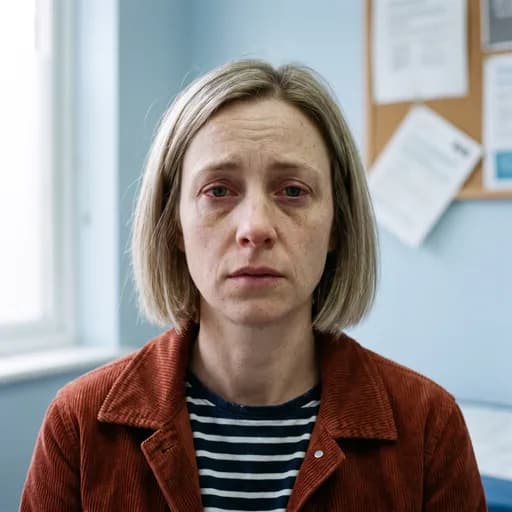
You are meeting Teddy's mother, Nora in the outpatient clinic. Nora brought Teddy by herself to his appointment as his father, Paul, had to work. She is expecting to talk about his next cycle of chemotherapy and does not yet know that his disease has progressed.
Objectives
- Deliver a clear headline that Teddy's disease has progressed again and that cure is not possible.
- Make room for Nora's response before returning to any clinical content.
- Explore the family's values, elicit what matters most for Teddy now, and offer possible treatment options.
- Reflect Nora's stated values back to her accurately and propose a concrete next step that follows from them.
- Introduce the idea of concurrent palliative and hospice care and the benefits this may provide.
Listen to the recording
Hear the 8m 40s recording
▶Transcript45
Hi, thanks for meeting with me.
Hi, Mrs. Lindgren. How are you and Teddy today?
He's asleep down the hall, he barely made it through the check-in. I've been up since about four, so… can we start with the scan? It's been three days.
Yeah. So, Mrs. Lindgren, um, lip smack I, I have some hard news about the scan. Um, is, is there any chance we could get Paul on the phone too?
He's at work, he couldn't get out of it. I told him I'd call him as soon as I knew. Just tell me, please.
Okay. Um, so unfortunately, on Teddy's most recent scan, his cancer does show progression. I'm, I'm really sorry.
... Okay. ... What does that leave us with.
Hmm. Yeah, so there are a couple of different options moving forward, um, but I just want to kind of acknowledge how difficult this must be to hear.
It is. ... I've been watching him sleep most of the day and stop reaching for his toys, so I think part of me already knew. What are the options.
Hmm.
Are...
Yeah. So I think... Mrs. Lindgren, I, I think we should talk a little bit about what your hopes are for, for Teddy at this point in order for me to make the best recommendation for your family.
My hope is he gets to be a kid. ... Paul found a trial, and somebody mentioned pills, etoposide. Which one buys him more time?
Mm-hmm. Yeah. So when you and Paul have discussed this, is time the most important thing to you?
Or you mentioned that you want Teddy to be a kid. Is his quality of life and his ability to, you know, do kid things, play, interact with you guys, the most important thing at this point?
... I don't know that Paul and I are in the same conversation right now. He reads studies at midnight and I watch Teddy breathe. ... If more treatment worked, what would he actually be like. Would he ever talk again.
Yeah. So some of these treatments, particularly the, the clinical trials, um, have the chance of making Teddy's quality of life worse, more difficult to care for, and, and really, um, lip smack making him less, less interactive with you and Paul.
Okay. ... And the pills. The etoposide. Is that going to do anything, or is it just something you can offer me?
I think we're at the point, Mrs. Lindgren, that we may be adding greater symptom burden, um, you know, things such as nausea, vomiting, um, sleepiness, fatigue, um, for the potential of a little bit more time.
So it's not going to save him.
No. He, he is going to die of his cancer, and I think time may be getting quite short.
Okay. ... Sorry, give me a second.
I know you and Paul have been caring, caring for Teddy so well, and, and this has been just an incredibly difficult journey for all of you.
...
I just wanna say... Go ahead, Mrs. Lindgren.
The end of therapy scan said no evidence of disease. We told both families he'd beaten it. ... Was that ever true?
Hmm. I think that we had really good news at, at some point, and we were really happy with that, but the truth is that this was likely always a terminal cancer, and we just didn't know how long Teddy had.
Okay. ... So what does the time he has left actually look like. What could his weeks be.
Yeah. Hmm. Yeah.
So based on what I'm seeing today, I'm thinking Teddy has weeks.
...
With you and Paul.
Weeks.
Yeah.
... Okay. What would make those weeks good for him. I don't want him in pain, and I don't want him getting stuck for a drug that isn't going to save him.
Mm. Yeah. So we should revisit this with Paul as well, but I hear you saying, you know, that Teddy's quality of life in the next few weeks is most important to you, that he's pain-free, that he's able to interact with you and Paul as much as possible.
Is that correct?
Yes. ... I want him home. I want him with us, not stuck here. ... How do I tell Paul this when he isn't even here.
Yeah. So, there is a service that can help you address Teddy's symptoms and focus on his comfort rather than his disease at home. That service is called hospice.
Are you familiar with that?
I've heard of it. ... It's what you call when you've stopped, isn't it. ... How do I tell Paul I'm ready for that when he's still sending me trial links.
Hmm. Yeah. So, this is something we're going to need to continue to explore more, but...
Okay.
... hospice in the adult world is focused entirely on, um, comfort, and patients do not continue to get disease-directed treatment. However, that is not the case in the pediatric hospice, uh, with the pediatric hospice service. You are able to continue to get disease-directed, cancer-directed therapies and treatment, and also get the benefitsassociated with hospice, such as more support at home and really, um, lip smacks uh, really intensive symptom management help.
Okay. ... So we could still try the pills if Paul needed to try something, and Teddy could still be home and comfortable. ... Can you be the one to help me say this to Paul? Or be in the room when I do. I don't think I can carry this to him alone.
Yeah. That's, that's understandable. Um, and we s- I certainly will support you through that conversation with Paul.
Um, and, and, you know, our whole team will, will be there for you a- as, as we continue these conversations.
Thank you. ... Can we set something up with Paul soon, like tomorrow if he can get off work. And somebody from the hospice side there too, so he hears it all at once instead of from me in pieces.
Yeah. That's a great idea. We will set up, um, a meeting or a phone call tomorrow, and I will reach out to the hospice service, um, to have them join as well.
Okay. ... So the goal isn't curing him anymore, it's time and comfort, and getting him home. I can say that back and it's true. ... I'm going to go get him from the playroom. Thank you for being straight with me.
Feedback
How to read this feedback
Every score is written as value / max, so you can see both the points earned and the points available. A spoken simulation can’t surface everything a real visit would, so when something couldn’t be judged fairly, the feedback labels it instead of holding it against you. Here’s what each label means.
(simulation limitation)The voice/text modality physically can't reveal it
e.g. eye contact, body language, facial affect, physical exam, EHR documentation
(no opportunity)The scenario never created the occasion
e.g. conversation ended before this step; situation never arose
(not applicable)Out of scope for this case
e.g. a domain that doesn't apply here
A not assessable item does not affect the score. The format did not give you a fair chance to show that behavior, so the item is excluded. That is different from “Not demonstrated,” where the moment was there and the skill didn’t come through. Only the second one reflects on how the encounter went.
For competency frameworks with levels, some scenarios can only assess a competency up to a certain level because the higher levels turn on behaviors a single spoken encounter can’t surface. When a scenario’s ceiling is below Level 4, that milestone is still shown for its formative value but is “Not in overall grade” . It doesn’t count toward the overall grade, so a case that can’t fully exercise a competency never reads as a shortfall.
Overall impression
- Strengths: This was an honest, warm, and well-structured conversation. The learner delivered devastating news clearly with a warning shot, gave truthful prognostic information when pressed (weeks), elicited and confirmed the family's values, and closed with a concrete, values-aligned plan that thoughtfully reconciled the mother's and father's differing stances via pediatric hospice. The offer to be present for the conversation with Paul was patient-centered and responsive.
- Priority gaps: The main opportunity is emotion-handling: at the highest-distress moments (silence, the question of whether the earlier good news was ever true, hearing weeks), the learner tended to pivot to information rather than staying with and exploring the grief. Empathic invitations to say more were largely absent.
- Top action items
- At peak emotion, name the feeling and stay silent or invite elaboration before returning to facts.
- When correcting a painful misconception (the earlier no evidence of disease), acknowledge the sense of betrayal explicitly before explaining.
- Make the final plan a clear personal recommendation and check the family's reaction to it directly.
- Broaden value-mapping beyond the time-vs-quality binary to capture what good days at home would look like.
Formative use only. This feedback is AI-generated for education and professional development. It is not a clinical judgment or a credentialing determination, and must not be used as the sole basis for any promotion, remediation, credentialing, or other consequential decision. Responsibility for evaluation and personnel decisions stays with the program and its faculty.
References
Mazewski C, Leary SES, Kang G, et al. Phase 3 randomized trial of high-dose methotrexate for young children with high-risk embryonal brain tumors: a report from the Children's Oncology Group. Neuro Oncol. 2025;27(10):2661-2673. doi:10.1093/neuonc/noaf103
Damodharan S, Wright-Nadkarni M, Abdelbaki MS, Dhall G. Infant embryonal CNS tumors: molecular insights and treatment considerations for contemporary pediatric neuro-oncology. Pediatr Blood Cancer. Published online August 20, 2026. doi:10.1002/pbc.70000
Krisch JM, Ermoian RP, Indelicato DJ, et al. Outcomes following radiation therapy for embryonal tumor with multilayered rosettes (ETMR): results from the Pediatric Proton/Photon Consortium Registry (PPCR). J Neurooncol. 2025;174(2):451-459. doi:10.1007/s11060-025-05063-4
Beck A, Gabler-Pamer L, Alencastro Veiga Cruzeiro G, et al. Cellular hierarchies of embryonal tumors with multilayered rosettes are shaped by oncogenic microRNAs and receptor-ligand interactions. Nat Cancer. 2025;6(6):1017-1035. doi:10.1038/s43018-025-00966-7
Ahmed MM, Carceller F, Bridges LR, et al. Exploring maintenance therapy in pediatric embryonal tumor with multilayered rosettes. J Pediatr Hematol Oncol. 2025;47(5):e290-e294. doi:10.1097/MPH.0000000000003046
Juhnke BO, Gessi M, Gerber NU, et al. Treatment of embryonal tumours with multilayered rosettes with carboplatin/etoposide induction and high-dose chemotherapy within the prospective P-HIT trial. Neuro Oncol. 2022;24(1):127-137. PMID: 33908610.
Khan S, Solano-Paez P, Suwal T, et al. Clinical phenotypes and prognostic features of embryonal tumours with multi-layered rosettes: a Rare Brain Tumor Registry study. Lancet Child Adolesc Health. 2021;5(11):800-813. PMID: 34599879.
Other examples
Goals of Care After Severe Neurologic Injury
A mother discusses her child's wishes after a severe brain injury, what CPR would involve, and whether continued invasive support fits those wishes.
Goals of Care: medically complex child
A PICU fellow talks with a mother about worsening respiratory failure, what returning home could mean, and how palliative care can support her family.
Disclosing an Incidental Finding of Metastatic Disease With No Known Primary
A man expects an appointment about back pain and learns that his scan suggests cancer in his spine. They discuss what happens next and how to involve his wife.
Goals of Care in Progressive Osteosarcoma
A father asks to drain the fluid around his daughter's lung and keep worsening cancer news from her. The conversation turns to comfort and how to include her.
48 Hours in the Hallway
Frank Miller, 78, has been boarding in an emergency department hallway bed for 48 hours while he waits for an ERCP and an inpatient bed, and his daughter Tiffany wants to know what is happening.
Addressing Hydroxyurea Nonadherence and Medical Mistrust
Monique Williams is the mother and primary caregiver of Jordan, thirteen, who has HbSS sickle cell disease.
Delivering a New Leukemia Diagnosis to a Family in the Emergency Department
Ethan Morales, a previously healthy 7 year old, came to the emergency department with two weeks of fatigue, bruising, intermittent fevers, and leg pain.
Informed Consent Discussion for Central Venous Catheter Placement in the PICU
Noah Harris, a previously healthy five year old, was admitted to the PICU about thirty minutes ago with septic shock secondary to pneumonia.
Pediatric Vaccine Hesitancy Counseling
Your patient, Ava Mitchell, is a healthy full term infant due for her first routine vaccine series today (DTaP, IPV, Hib, PCV20, Rotavirus, and Hepatitis B).